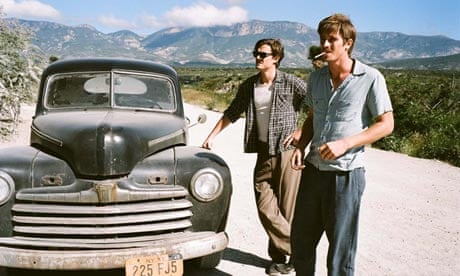
Excerpt From On the Road- Author Jack Kerouac

 On the Road – review | Drama films | The Guardian

 I first met Dean not long after my wife and I split up. I had just gotten over a serious illness that I won’t bother to talk about, except that it had something to do with the miserably weary split-up and my feeling that everything was dead. With the coming of Dean Moriarty began the part of my life you could call my life on the road. Before that I’d often dreamed of going West to see the country, always vaguely planning and never taking off. Dean is the perfect guy for the road because he actually was born on the road, when his parents were passing through Salt Lake City in 1926, in a jalopy, on their way to Los Angeles. First reports of him came to me through Chad King, who’d shown me a few letters from him written in a New Mexico reform school. I was tremendously interested in the letters because they so naively and sweetly asked Chad to teach him all about Nietzsche and all the wonderful intellectual things that Chad knew. At one point Carlo and I talked about the letters and wondered if we would ever meet the strange Dean Moriarty. This is all far back, when Dean was not the way he is today, when he was a young jailkid shrouded in mystery. Then news came that Dean was out of reform school and was coming to New York for the first time; also there was talk that he had just married a girl called Marylou.
One day I was hanging around the campus and Chad and Tim Gray told me Dean was staying in a cold-water pad in East Harlem, the Spanish Harlem. Dean had arrived the night before, the first time in New York, with his beautiful little sharp chick Marylou; they got off the Greyhound bus at 50th Street and cut around the corner looking for a place to eat and went right in Hector’s, and since then Hector’s cafeteria has always been a big symbol of New York for Dean. They spent money on beautiful big glazed cakes and creampuffs.
All this time Dean was telling Marylou things like this: “Now, darling, here we are in New York and although I haven’t quite told you everything that I was thinking about when we crossed Missouri and especially at the point when we passed the Boon ville reformatory which reminded me of my jail problem, it is absolutely necessary now to postpone all those leftover things concerning our personal lovethings and at once begin thinking of specific worklife plans . . .” and so on in the way that he had in those early days.
I went to the cold-water flat with the boys, and Dean came to the door in his shorts. Marylou was jumping off the couch; Dean had dispatched the occupant of the apartment to the kitchen, probably to make coffee, while he proceeded with his love-problems, for to him sex was the one and only holy and important thing in life, although he had to sweat and curse to make a living and so on. You saw that in the way he stood bobbing his head, always looking down, nodding, like a young boxer to instructions, to make you think he was listening to every word, throwing in a thousand “Yeses” and “That’s rights.” My first impression of Dean was of a young Gene Autry—trim, thin-hipped, blue-eyed, with a real Oklahoma accent—a sideburned hero of the snowy West. In fact he’d just been working on a ranch, Ed Wall’s in Colorado, before marrying Marylou and coming East. Marylou was a pretty blonde with immense ringlets of hair like a sea of golden tresses; she sat there on the edge of the couch with her hands hanging in her lap and her smoky blue country eyes fixed in a wide stare because she was in an evil gray New York pad that she’d heard about back West, and waiting like a longbodied emaciated Modigliani surrealist woman in a serious room. But, outside of being a sweet little girl, she was awfully dumb and capable of doing horrible things. That night we all drank beer and pulled wrists and talked till dawn, and in the morning, while we sat around dumbly smoking butts from ashtrays in the gray light of a gloomy day, Dean got up nervously, paced around, thinking, and decided the thing to do was to have Marylou make breakfast and sweep the floor. “In other words we’ve got to get on the ball, darling, what I’m saying, otherwise it’ll be fluctuating and lack of true knowledge or crystallization of our plans.” Then I went away.
During the following week he confided in Chad King that he absolutely had to learn how to write from him; Chad said I was a writer and he should come to me for advice. Meanwhile Dean had gotten a job in a parking lot, had a fight with Marylou in their Hoboken apartment—God knows why they went there—and she was so mad and so down deep vindictive that she reported to the police some false trumped-up hysterical crazy charge, and Dean had to lam from Hoboken. So he had no place to live. He came right out to Paterson, New Jersey, where I was living with my aunt, and one night while I was studying there was a knock on the door, and there was Dean, bowing, shuffling obsequiously in the dark of the hall, and saying, “Hel-lo, you remember me—Dean Moriarty? I’ve come to ask you to show me how to write.”
“And where’s Marylou?” I asked, and Dean said she’d apparently whored a few dollars together and gone back to Denver—“the whore!” So we went out to have a few beers because we couldn’t talk like we wanted to talk in front of my aunt, who sat in the living room reading her paper. She took one look at Dean and decided that he was a madman.
In the bar I told Dean, “Hell, man, I know very well you didn’t come to me only to want to become a writer, and after all what do I really know about it except you’ve got to stick to it with the energy of a benny addict.” And he said, “Yes, of course, I know exactly what you mean and in fact all those problems have occurred to me, but the thing that I want is the realization of those factors that should one depend on Schopenhauer’s dichotomy for any inwardly realized . . .” and so on in that way, things I understood not a bit and he himself didn’t. In those days he really didn’t know what he was talking about; that is to say, he was a young jailkid all hung-up on the wonderful possibilities of becoming a real intellectual, and he liked to talk in the tone and using the words, but in a jumbled way, that he had heard from “real intellectuals” —although, mind you, he wasn’t so naive as that in all other things, and it took, him just a few months with Carlo Marx to become completely in there with all the terms and jargon. Nonetheless we understood each other on other levels of madness, and I agreed that he could stay at my house till he found a job and furthermore we agreed to go out West sometime. That was the winter of 1947.
One night when Dean ate supper at my house—he already had, the parking-lot job in New York—he leaned over my shoulder as I typed rapidly away and said, “Come on man, those girls won’t wait, make it fast.”
I said, “Hold on just a minute, I’ll be right with you soon as I finish this chapter,” and it was one of the best chapters in the book. Then I dressed and off we flew to New York to meet some girls. As we rode in the bus in the weird phosphorescent void of the Lincoln Tunnel we leaned on each other with fingers waving and yelled and talked excitedly, and I was beginning to get the bug like Dean. He was simply a youth tremendously excited with life, and though he was a con-man, he was only conning because he wanted so much to live and to get involved with people who would otherwise pay no attention to him. He was conning me and I knew it (for room and board and “how-to-write,” etc.), and he knew I knew (this has been the basis of our relationship), but I didn’t care and we got along fine—no pestering, no catering; we tiptoed around each other like heartbreaking new friends. I began to learn from him as much as he probably learned from me. As far as my work was concerned he said, “Go ahead, everything you do is great.” He watched over my shoulder as I wrote stories, yelling, “Yes! That’s right! Wow! Man!” and “Phew!” and wiped his face with his handkerchief. “Man, wow, there’s so many things to do, so many things to write! How to even begin to get it all down and without modified restraints and all hung-up on like literary inhibitions and grammatical fears . . .”
“That’s right, man, now you’re talking.” And a kind of holy lightning I saw flashing from his excitement and his visions, which he described so torrentially that people in buses looked around to see the “overexcited nut.” In the West he’d spent a third of his time in the poolhall, a third in jail, and a third in the public library. They’d seen him rushing eagerly down the winter streets, bareheaded, carrying books to the poolhall, or climbing trees to get into the attics of buddies where he spent days reading or hiding from the law.
We went to New York—I forget what the situation was, two colored girls—there were no girls there; they were supposed to meet him in a diner and didn’t show up. We went to his parking lot where he had a few things to do—change his clothes in the shack in back and spruce up a bit in front of a cracked mirror and so on, and then we took off. And that was the night Dean met Carlo Marx. A tremendous thing happened when Dean met Carlo Marx. Two keen minds that they are, they took to each other at the drop of a hat. Two piercing eyes glanced into two piercing eyes—the holy con-man with the shining mind, and the sorrowful poetic con-man with the dark mind that is Carlo Marx. From that moment on I saw very little of Dean, and I was a little sorry too. Their energies met head-on, I was a lout compared, I couldn’t keep up with them. The whole mad swirl of everything that was to come began then; it would mix up all my friends and all I had left of my family in a big dust cloud over the American Night. Carlo told him of Old Bull Lee, Elmer Hassel, Jane: Lee in Texas growing weed, Hassel on Riker’s Island, Jane wandering on Times Square in a benzedrine hallucination, with her baby girl in her arms and ending up in Bellevue. And Dean told Carlo of unknown people in the West like Tommy Snark, the clubfooted poolhall rotation shark and cardplayer and queer saint. He told him of Roy Johnson, Big Ed Dunkel, his boyhood buddies, his street buddies, his innumerable girls and sex-parties and pornographic pictures, his heroes, heroines, adventures. They rushed down the street together, digging everything in the early way they had, which later became so much sadder and perceptive and blank. But then they danced down the streets like dingledodies, and I shambled after as I’ve been doing all my life after people who interest me, because the only people for me are the mad ones, the ones who are mad to live, mad to talk, mad to be saved, desirous of everything at the same time, the ones who never yawn or say a commonplace thing, but burn, burn, burn like fabulous yellow roman candles exploding like spiders across the stars and in the middle you see the blue centerlight pop and everybody goes “Awww!” What did they call such young people in Goethe’s Germany? Wanting dearly to learn how to write like Carlo, the first thing you know, Dean was attacking him with a great amorous soul such as only a con-man can have. “Now, Carlo, let me speak—here’s what I’m saying . . .”. I didn’t see them for about two weeks, during which time they cemented their relationship to fiendish allday-allnight talk proportions.
Then came spring, the great time of traveling, and everybody in the scattered gang was getting ready to take one trip or another. I was busily at work on my novel and when I came to the halfway mark, after a trip down South with my aunt to visit my brother Rocco, I got ready to travel West for the very first time.
Dean had already left. Carlo and I saw him off at the 34th Street Greyhound station. Upstairs they had a place where you could make pictures for a quarter. Carlo took off his glasses and looked sinister. Dean made a profile shot and looked coyly around. I took a straight picture that made me look like a thirty-year-old Italian who’d kill anybody who said anything against his mother. This picture Carlo and Dean neatly cut down the middle with a razor and saved a half each in their wallets. Dean was wearing a real Western business suit for his big trip back to Denver; he’d finished his first fling in New York. I say fling, but he only worked like a dog in parking lots. The most fantastic parking-lot attendant in the world, he can back a car forty miles an hour into a tight squeeze and stop at the wall, jump out, race among fenders, leap into another car, circle it fifty miles an hour in a narrow space, back swiftly into tight spot, hump, snap the car with the emergency so that you see it bounce as he flies out; then clear to the ticket shack, sprinting like a track star, hand a ticket, leap into a newly arrived car before the owner’s half out, leap literally under him as he steps out, start the car with the door flapping, and roar off to the next available spot, arc, pop in, brake, out, run; working like that without pause eight hours a night, evening rush hours and after-theater rush hours, in greasy wino pants with a frayed fur-lined jacket and beat shoes that flap. Now he’d bought a new suit to go back in; blue with pencil stripes, vest and all—eleven dollars on Third Avenue, with a watch and watch chain, and a portable typewriter with which he was going to start writing in a Denver rooming house as soon as he got a job there. We had a farewell meal of franks and beans in a Seventh Avenue Riker’s, and then Dean got on the bus that said Chicago and roared off into the night. There went our wrangler. I promised myself to go the same way when spring really bloomed and opened up the land.
And this was really the way that my whole road experience began, and the things that were to come are too fantastic not to tell.

Tyler M. Williams reviews This Life


Martin Hägglund. This Life: Secular Faith and Spiritual Freedom. New York: Pantheon, 2019. 464 pp.

Review by Tyler M. Williams

This Life presents nothing less than a theory of the meaning of life. In this ambitious, highly persuasive book, Martin Hägglund challenges the religious teleology that posits a transcendent, eternal afterlife as the culminating aspiration of a meaningful, mortal life. Arguing that all religious faith in eternal salvation depends upon a sense of value and responsibility that can only be accounted for secularly, Hägglund guides his reader through early Christian confessional literature, modern philosophy, contemporary literature, the American civil rights movement, and ongoing debates about the limits of capitalism to highlight the intrinsic—indeed, the constitutive—role temporal finitude plays in oureveryday commitments. Finitude, the mortal fact of this life, rather than a divinely timeless afterlife, solely motivates why and how we live our lives the way we do. “The depths of life are not revealed through faith in eternity,” Hägglund writes in sum. “Rather, our spiritual commitments proceed from caring for what will be irrevocably lost and remaining faithful to what gives no final guarantee” (p. 36).

Take, for instance, those profound experiences of grief or love so often evoked to justify a religious faith in eternity. A husband grieving the death of his wife longs for their reunion in the afterlife. A man reflects on his adolescence and realizes that the misdeeds he committed in his youth to win the affections of his friends were actually veiled cravings for the incorruptible love of God’s friendship. Hägglund argues that both of these scenarios work against themselves because the eternal fulfillment in which they profess faith is incompatible with the value they yearn to preserve. The sorrow C. S. Lewis feels for his deceased wife in A Grief Observed (1961) is irreconcilable with religious faith in their heavenly reunion. Hägglund argues that Lewis grieves the loss of his wife for strictly secular reasons. On the one hand, Lewis can only grieve her death because she is finite and irreplaceable. Faith in their eternal reunion would eliminate this grief, since death would not be perceived as a loss at all. On the other hand, the relationship over which Lewis now grieves would have never been possible without temporal finitude, since care and devotion can only be bestowed upon something vulnerable to loss. The prospect of eternity would nullify both the ability for care and devotion and the need to care or devote oneself. I neither could—nor would I need—to care for something (or someone) eternally guaranteed to me (p. 66). Likewise, Augustine’s desire for God’s incorruptible friendship in Confessions is anathema to the mortal condition of friendship itself. Friendship is constituted by the time one devotes to sustaining that friendship, always and necessarily in the face of its possible ruin or betrayal. Friendship with an eternal, perfect, unbetrayable, and unbetraying God would eliminate the temporal commitment that constitutes any chance of friendship in the first place (p. 90). 

Rather than deriving their value from the religious faith in eternity they claim, these experiences of grief and love are only meaningful because of their secular commitment to this (mortal) life. They depend intrinsically on what Hägglund calls “secular faith.” As a concept, “secular faith” names the basic temporal horizon that sustains my hope for the future (p. 140). In its most existential sense, secular faith amounts to “the faith that life is worth living,” which Hägglund argues can only be accounted for secularly, since how I ought to live my life depends fundamentally on the commitments I make for myself in the face of a future that remains uncertain to me. My secular faith means that I care for my life, I protect my commitments, and I aspire to fulfill my goals. Yet, all of these motivational, relational, and protective aspects of this life hinge on their finitude, on the fact that they are vulnerable to future loss. Precisely because my life is not eternal, because it matters what I do with my time, I can care about my life, commit myself to its betterment, and have faith in its meaningfulness (pp. 50–51). A commitment to enhancing secular faith ultimately builds the possibility of “spiritual freedom,” which for Hägglund means the ability to question and decide how I ought to live my life (p. 176). The second half of This Life thus extends Hägglund’s earlier critique of religious faith to a defense, via an extensive reading of the concept of “value” in Marx, of the existential necessity of “democratic socialism” and progressive politics more generally. Exactly what “democratic socialism” pragmatically entails remains relatively unclear in Hägglund’s account (p. 284), especially concerning the ambiguous connection he draws between “spiritual freedom” and “state sovereignty” (pp. 266–67). However, the philosophical basis Hägglund offers for a future of progressive politics remains crucial: capitalism, as a socioeconomic and political paradigm that limits “spiritual freedom,” not only denies us the ability to value ourselves but, moreover, demands a politics of “secular faith” committed solely to the improvement of the material conditions of this life alone (p. 332). 

Readers who are already familiar with the spatiotemporal logic of “survival” Hägglund develops via Jacques Derrida in Radical Atheism (2008) and his “chronolibinal” reading of modernist literature in Dying for Time (2012) will recognize this core argument that animates This Life. Yet, This Life remains a distinct and important contribution to contemporary philosophy not only because of its impressive lucidity (by now a Hägglundian trademark), but also because its wrests “faith” from religion’s grip and builds on its back a fundamentally secular structure of emancipatory politics and social justice. This Life is a rare accomplishment. Hägglund has written a book that is as rigorous as it is approachable, as incisive as it is patient. A veritable trove of ideas and provocations, This Life is a rewarding book that deserves exactly what it demands: close, engaged reading by a wide readership.

the bitter, the hollow and the mirthless laugh -Samuel Beckett (Goodreads.com)


Samuel Beckett

“Of all the laughs that strictly speaking are not laughs, but modes of ululation, only three I think need detain us, I mean the bitter, the hollow and the mirthless. They correspond to successive… how shall I say successive… suc… successive excoriations of the understanding, and the passage from the one to the other is the passage from the lesser to the greater, from the lower to the higher, from the outer to the inner, from the gross to the fine, from the matter to the form. The laugh that now is mirthless once was hollow, the laugh that once was hollow once was bitter. And the laugh that once was bitter? Eyewater, Mr. Watt, eyewater. But do not let us waste our time with that. . . . The bitter, the hollow and—Haw! Haw!— the mirthless. The bitter laugh laughs at that which is not good, it is the ethical laugh. The hollow laugh laughs at that which is not true, it is the intellectual laugh. Not good! Not true! Well well. But the mirthless laugh is the dianoetic laugh, down the snout—Haw!—so. It is the laugh of laughs, the risus purus, the laugh laughing at the laugh, the beholding, the saluting of the highest joke, in a word the laugh that laughs—silence please—at that which is unhappy”.”

― Samuel Beckett, Watt

FAHRENHEIT 451- (extract) -by Ray Bradbury


...“Thousands on the roads, the abandoned railtracks, tonight, bums on the outside, libraries inside. It wasn’t planned, at first. Each man had a book he wanted to remember, and did. Then, over a period of twenty years or so, we met each other, traveling, and got the loose network together and set out a plan. The most important single thing we had to pound into ourselves is that we were not important, we mustn’t be pedants; we were not to feel superior to anyone else in the world. We’re nothing more than dust jackets for books, of no significance otherwise. Some of us live in small towns. Chapter One of Thoreau’s Walden in Green River, Chapter Two in Willow Farm, Maine. Why, there’s one town in Maryland, only twenty-seven people, no bomb’ll ever touch that town, is the compete essays of a man named Bertrand Russell. Pick up that town, almost, and flip the pages, so many pages to a person. And when the war’s over, some day, some year, the books can be written again, the people will be called in, one by one, to recite what they know and we’ll set it up in type until another Dark Age, when we might have to do the whole damn thing over again. But that’s the wonderful thing about man; he never gets so discouraged or disgusted that he gives up doing it all over again, because he knows very well it is important and worth the doing.”

“What do we do tonight?” asked Montag.

“Wait,” said Granger. “And move downstream a little ways, just in case.”

He began throwing dust and dirt in the fire.

The other men helped, and Montag helped, and there, in the wilderness, the men all moved their hands, putting out the fire together.

º º º

They stood by the river in the starlight.

Montag saw the luminous dial of his waterproof. Five. Five o’clock in the morning. Another year ticked by in a single hour, and dawn waiting beyond the far bank of the river.

“Why do you trust me?” said Montag.

A man moved in the darkness.

“The look of you’s enough. You haven’t seen yourself in a mirror lately. Beyond that, the city has never cared so much about us to bother with an elaborate chase like this to find us. A few crackpots with verses in their heads can’t touch them, and they know it and we know it; everyone knows it. So long as the vast population doesn’t wander about quoting the Magna Carta and the Constitution, it’s all right. The firemen were enough to check that, now and then. No, the cities don’t bother us. And you look like hell.”

They moved along the bank of the river, going south. Montag tried to see the men’s faces, the old faces he remembered from the firelight, lined and tired. He was looking for a brightness, a resolve, a triumph over tomorrow that hardly seemed to be there. Perhaps he had expected their faces to burn and glitter with the knowledge they carried, to glow as lanterns glow, with the light in them. But all the light had come from the campfire, and these men had seemed no different than any others who had run a long race, searched a long search, seen good things destroyed, and now, very late, were gathered to wait for the end of the party and the blowing out of the lamps. They weren’t at all certain that the things they carried in their heads might make every future dawn glow with a purer light, they were sure of nothing save that the books were on file behind their quiet eyes, the books were waiting, with their pages uncut, for the customers who might come by in later years, some with clean and some with dirty fingers.

Montag squinted from one face to another as they walked.

“Don’t judge a book by its cover,” someone said.

And they all laughed quietly, moving downstream.

º º º

There was a shriek and the jets from the city were gone overhead long before the men looked up. Montag stared back at the city, far down the river, only a faint glow now.

“My wife’s back there.”

“I’m sorry to hear that. The cities won’t do well in the next few days,” said Granger.

“It’s strange, I don’t miss her, it’s strange I don’t feel much of anything,” said Montag. “Even if she dies, I realized a moment ago, I don’t think I’ll feel sad. It isn’t right. Something must be wrong with me.”

“Listen,” said Granger, taking his arm, and walking with him, holding aside the bushes to let him pass. “When I was a boy my grandfather died, and he was a sculptor. He was also a very kind man who had a lot of love to give the world, and he helped clean up the slum in our town; and he made toys for us and he did a million things in his lifetime; he was always busy with his hands. And when he died, I suddenly realized I wasn’t crying for him at all, but for all the things he did. I cried because he would never do them again, he would never carve another piece of wood or help us raise doves and pigeons in the back yard or play the violin the way he did, or tell us jokes the way he did. He was part of us and when he died, all the actions stopped dead and there was no one to do them just the way he did. He was individual. He was an important man. I’ve never gotten over his death. Often I think, what wonderful carvings never came to birth because he died. How many jokes are missing from the world, and how many homing pigeons untouched by his hands. He shaped the world. He did things to the world. The world was bankrupted of ten million fine actions the night he passed on.”

Montag walked in silence. “Millie, Millie,” he whispered. “Millie.”

“What?”

“My wife, my wife. Poor Millie, poor, poor Millie. I can’t remember anything. I think of her hands but I don’t see them doing anything at all. They just hang there at her sides or they lie there on her lap or there’s a cigarette in them, but that’s all.”

Montag turned and glanced back.

What did you give to the city, Montag?

Ashes.

What did the others give to each other?

Nothingness.

Granger stood looking back with Montag. “Everyone must leave something behind when he dies, my grandfather said. A child or a book or a painting or a house or a wall built or a pair of shoes made. Or a garden planted. Something your hand touched some way so your soul has somewhere to go when you die, and when people look at that tree or that flower you planted, you’re there. It doesn’t matter what you do, he said, so long as you change something from the way it was before you touched it into something that’s like you after you take your hands away. The difference between the man who just cuts lawns and a real gardener is in the touching, he said. The lawn-cutter might just as well not have been there at all; the gardener will be there a lifetime.”

Granger moved his hand. “My grandfather showed me some V-2 rocket films once, fifty years ago. Have you ever seen the atom bomb mushroom from two hundred miles up? It’s a pinprick, it’s nothing. With the wilderness all around it.

“My grandfather ran off the V-2 rocket film a dozen times and then hoped that some day our cities would open up more and let the green and the land and the wilderness in more, to remind people that we’re allotted a little space on earth and that we survive in that wilderness that can take back what it has given, as easily as blowing its breath on us or sending the sea to tell us we are not so big. When we forget how close the wilderness is in the night, my grandpa said, some day it will come in and get us, for we will have forgotten how terrible and real it can be. You see?” Granger turned to Montag. “Grandfather’s been dead for all these years, but if you lifted my skull, by God, in the convolutions of my brain you’d find the big ridges of his thumbprint. He touched me. As I said, earlier, he was a sculptor. ‘I hate a Roman named Status Quo!’ he said to me. ‘Stuff your eyes with wonder,’ he said, ‘live as if you’d drop dead in ten seconds. See the world. It’s more fantastic than any dream made or paid for in factories. Ask no guarantees, ask for no security, there never was such an animal. And if there were, it would be related to the great sloth which hangs upside down in a tree all day every day, sleeping its life away. To hell with that,’ he said, ‘shake the tree and knock the great sloth down on his ass.’ ”

“Look!” cried Montag.

And the war began and ended in that instant.

Later, the men around Montag could not say if they had really seen anything. Perhaps the merest flourish of light and motion in the sky. Perhaps the bombs were there, and the jets, ten miles, five miles, one mile up, for the merest instant, like grain thrown over the heavens by a great sowing hand, and the bombs drifting with dreadful swiftness, yet sudden slowness, down upon the morning city they had left behind. The bombardment was to all intents and purposes finished, once the jets had sighted their target, alerted their bombardier at five thousand miles an hour; as quick as the whisper of a scythe the war was finished. Once the bomb release was yanked, it was over. Now, a full three seconds, all of the time in history, before the bombs struck, the enemy ships themselves were gone half around the visible world, like bullets in which a savage islander might not believe because they were invisible; yet the heart is suddenly shattered, the body falls in separate motions and the blood is astonished to be freed on the air; the brain squanders its few precious memories and, puzzled, dies.

This was not to be believed. It was merely a gesture. Montag saw the flirt of a great metal fist over the far city and he knew the scream of the jets that would follow, would say, after the deed, disintegrate, leave no stone on another, perish. Die.

Montag held the bombs in the sky for a single moment, with his mind and his hands reaching helplessly up at them. “Run!” he cried to Faber. To Clarisse, “Run!” To Mildred, “Get out, get out of there!” But Clarisse, he remembered, was dead. And Faber was out; there in the deep valleys of the country somewhere the five A.M. bus was on its way from one desolation to another. Though the desolation had not yet arrived, was still in the air, it was certain as man could make it. Before the bus had run another fifty yards on the highway, its destination would be meaningless, and its point of departure changed from metropolis to junkyard.

And Mildred . . .

Get out, run!

He saw her in her hotel room somewhere now in the half second remaining with the bombs a yard, a foot, an inch from her building. He saw her leaning toward the great shimmering walls of color and motion where the family talked and talked and talked to her, where the family prattled and chatted and said her name and smiled at her and said nothing of the bomb that was an inch, now a half inch, now a quarter inch from the top of the hotel. Leaning into the wall as if all the hunger of looking would find the secret of her sleepless unease there. Mildred, leaning anxiously nervously, as if to plunge, drop, fall into that swarming immensity of color to drown in its bright happiness.

The first bomb struck.

“Mildred!”

Perhaps, who would ever know? perhaps the great broadcasting stations with their beams of color and light and talk and chatter went first into oblivion.

Montag, falling flat, going down, saw or felt, or imagined he saw or felt the walls go dark in Millie’s face, heard her screaming, because in the millionth part of time left, she saw her own face reflected there, in a mirror instead of a crystal ball, and it was such a wildly empty face, all by itself in the room, touching nothing, starved and eating of itself, that at last she recognized it as her own and looked quickly up at the ceiling as it and the entire structure of the hotel blasted down upon her, carrying her with a million pounds of brick, metal, plaster, and wood, to meet other people in the hives below, all on their quick way down to the cellar where the explosion rid itself of them in its own unreasonable way.

I remember. Montag clung to the earth. I remember. Chicago. Chicago a long time ago. Millie and I. That’s where we met! I remember now. Chicago. A long time ago.

The concussion knocked the air across and down the river, turned the men over like dominoes in a line, blew the water in lifting sprays, and blew the dust and made the trees above them mourn with a great wind passing away south. Montag crushed himself down, squeezing himself small, eyes tight. He blinked once. And in that instant saw the city, instead of the bombs, in the air. They had displaced each other. For another of those impossible instants the city stood, rebuilt and unrecognizable, taller than it had ever hoped or strived to be, taller than man had built it, erected at last in gouts of shattered concrete and sparkles of torn metal into a mural hung like a reversed avalanche, a million colors, a million oddities, a door where a window should be, a top for a bottom, a side for a back, and then the city rolled over and fell down dead.

The sound of its death came after.

º º º

Montag, lying there, eyes gritted shut with dust, a fine wet cement of dust in his now shut mouth, gasping and crying, now thought again, I remember, I remember, I remember something else. What is it? Yes, yes, part of Ecclesiastes. Part of Ecclesiastes and Revelation. Part of that book, part of it, quick now, quick before it gets away, before the shock wears off, before the wind dies. Book of Ecclesiastes. Here. He said it over to himself silently, lying flat to the trembling earth, he said the words of it many times and they were perfect without trying and there was no Denham’s Dentifrice anywhere, it was just the Preacher by himself, standing there in his mind, looking at him. . . .

“There,” said a voice.

The men lay gasping like fish laid out on the grass. They held to the earth as children hold to familiar things, no matter how cold or dead, no matter what has happened or will happen, their fingers were clawed into the dirt, and they were all shouting to keep their eardrums from bursting, to keep their sanity from bursting, mouths open, Montag shouting with them, a protest against the wind that ripped their faces and tore at their lips, making their noses bleed.

Montag watched the great dust settle and the great silence move down upon their world. And lying there it seemed that he saw every single grain of dust and every blade of grass and that he heard every cry and shout and whisper going up in the world now. Silence fell down in the sifting dust, and all the leisure they might need to look around, to gather the reality of this day into their senses.

Montag looked at the river. We’ll go on the river. He looked at the old railroad tracks. Or we’ll go that way. Or we’ll walk on the highways now, and we’ll have time to put things into ourselves. And some day, after it sets in us a long time, it’ll come out our hands and our mouths. And a lot of it will be wrong, but just enough of it will be right. We’ll just start walking today and see the world and the way the world walks around and talks, the way it really looks. I want to see everything now. And while none of it will be me when it goes in, after a while it’ll all gather together inside and it’ll be me. Look at the world out there, my God, my God, look at it out there, outside me, out there beyond my face and the only way to really touch it is to put it where it’s finally me, where it’s in the blood, where it pumps around a thousand times ten thousand a day. I’ll get hold of it so it’ll never run off. I’ll hold onto the world tight some day. I’ve got one finger on it now; that’s a beginning.

The wind died.

The other men lay awhile, on the dawn edge of sleep, not yet ready to rise up and begin the day’s obligations, its fires and foods, its thousand details of putting foot after foot and hand after hand. They lay blinking their dusty eyelids. You could hear them breathing fast, then slower, then slow. . . .

Montag sat up.

He did not move any farther, however. The other men did likewise. The sun was touching the black horizon with a faint red tip. The air was cold and smelled of a coming rain.

Silently, Granger arose, felt of his arms and legs, swearing, swearing incessantly under his breath, tears dripping from his face. He shuffled down to the river to look upstream.

“It’s flat,” he said, a long time later. “City looks like a heap of baking powder. It’s gone.” And a long time after that. “I wonder how many knew it was coming? I wonder how many were surprised?”

And across the world, thought Montag, how many other cities dead? And here in our country, how many? A hundred, a thousand?

Someone struck a match and touched it to a piece of dry paper taken from their pocket, and shoved this under a bit of grass and leaves, and after a while added tiny twigs which were wet and sputtered but finally caught, and the fire grew larger in the early morning as the sun came up and the men slowly turned from looking up river and were drawn to the fire, awkwardly, with nothing to say, and the sun colored the back of their necks as they bent down.

Granger unfolded an oilskin with some bacon in it. “We’ll have a bite. Then we’ll turn around and walk upstream. They’ll be needing us up that way.”

Someone produced a small frying pan and the bacon went into it and the frying pan was set on the fire. After a moment the bacon began to flutter and dance in the pan and the sputter of it filled the morning air with its aroma. The men watched this ritual silently.

Granger looked into the fire. “Phoenix.”

“What?”

“There was a silly damn bird called a Phoenix back before Christ, every few hundred years he built a pyre and burned himself up. He must have been first cousin to Man. But every time he burnt himself up he sprang out of the ashes, he got himself born all over again. And it looks like we’re doing the same thing, over and over, but we’ve got one damn thing the Phoenix never had. We know the damn silly thing we just did. We know all the damn silly things we’ve done for a thousand years and as long as we know that and always have it around where we can see it, some day we’ll stop making the goddam funeral pyres and jumping in the middle of them. We pick up a few more people that remember, every generation.”

He took the pan off the fire and let the bacon cool and they ate it, slowly, thoughtfully.

“Now, let’s get on upstream,” said Granger. “And hold onto one thought: You’re not important. You’re not anything. Some day the load we’re carrying with us may help someone. But even when we had the books on hand, a long time ago, we didn’t use what we got out of them. We went right on insulting the dead. We went right on spitting in the graves of all the poor ones who died before us. We’re going to meet a lot of lonely people in the next week and the next month and the next year. And when they ask us what we’re doing, you can say, We’re remembering. That’s where we’ll win out in the long run. And some day we’ll remember so much that we’ll build the biggest goddam steamshovel in history and dig the biggest grave of all time and shove war in and cover it up. Come on now, we’re going to go build a mirror factory first and put out nothing but mirrors for the next year and take a long look in them.”

They finished eating and put out the fire. The day was brightening all about them as if a pink lamp had been given more wick. In the trees, the birds that had flown away quickly now came back and settled down.

Montag began walking and after a moment found that the others had fallen in behind him, going north. He was surprised, and moved aside to let Granger pass, but Granger looked at him and nodded him on. Montag went ahead. He looked at the river and the sky and the rusting track going back down to where the farms lay, where the barns stood full of hay, where a lot of people had walked by in the night on their way from the city. Later, in a month or six months, and certainly not more than a year, he would walk along here again, alone, and keep right on going until he caught up with the people.

But now there was a long morning’s walk until noon, and if the men were silent it was because there was everything to think about and much to remember. Perhaps later in the morning, when the sun was up and had warmed them they would begin to talk, or just say the things they remembered, to be sure they were there, to be absolutely certain that things were safe in them. Montag felt the slow stir of words, the slow simmer. And when it came his turn, what could he say, what could he offer on a day like this, to make the trip a little easier? To everything there is a season. Yes. A time to break down, and a time to build up. Yes. A time to keep silence and a time to speak. Yes, all that. But what else. What else? Something, something. . . .

And on either side of the river was there a tree of life, which bare twelve manner of fruits, and yielded her fruit every month; And the leaves of the tree were for the healing of the nations.

Yes, thought Montag, that’s the one I’ll save for noon. For noon. . . .

When we reach the city.

The Road Not Taken- Robert Frost

 WORLD POETRY DAY, MARCH 21, 2026

“The Road Not Taken” by Robert Frost (1874-1963)

Two roads diverged in a yellow wood,
Robert Frost poetAnd sorry I could not travel both
And be one traveler, long I stood
And looked down one as far as I could
To where it bent in the undergrowth;

Then took the other, as just as fair,
And having perhaps the better claim,
Because it was grassy and wanted wear;
Though as for that the passing there
Had worn them really about the same,

And both that morning equally lay
In leaves no step had trodden black.
Oh, I kept the first for another day!
Yet knowing how way leads on to way,
I doubted if I should ever come back.

I shall be telling this with a sigh
Somewhere ages and ages hence:
Two roads diverged in a wood, and I—
I took the one less traveled by,
And that has made all the difference.

Markets are holy, People disposable - Dimitris Kantalis


They call us morons when we notice patterns,
when we ask why wealth flows upward
like a law of physics
and poverty is treated as a personal failure.

Under the banner of the neoliberal gospel,
markets are holy, people disposable,
and exploitation is rebranded as “opportunity.”
The vote is free, they say,
but the choices are pre-owned.

We live in the precariat,
a class without contracts, without futures,
told to be grateful for instability
by those insulated from it.
They accuse us of being short-sighted
while strip-mining the next generation.

This system isn’t broken—it’s absurd on purpose.
It works exactly as designed:
profits privatized, risks socialized,
and frustration redirected sideways
so we blame each other instead of the architects.

From factories to platforms to borders,
exploitation is policy, not accident.
A spreadsheet decides who rests, who starves,
who is “essential” enough to be sacrificed.

But history doesn’t belong to shareholders.
When the governed stop asking politely,
when fear expires and solidarity scales,
the ruled remember they can emancipate
not individually, not someday,
but together, and now.

Call that radical.
Call that dangerous.
Call us morons again.
The real threat is that we’re finally
paying attention.

Archetype bias- Dimitris Kantalis


In the heart of the collective, an archetype grows,

As the weight of the institutions endlessly flows.
But the soul of the individual fights to be free,
From the public opinion that swells like the sea.

Though the conscience is burdened by shadows of shame,
In the spirit of honor, we kindle the flame.
And we cast off the despicable bureaucrats' greed
To plant in the garden a holier seed.
Dim@Kantalis

The path is cut by tenacity alone- Dimitris Kantalis


The path is cut by tenacity alone,

Through shifting sands and walls of jagged stone.

To walk with honor is to choose the light,
Even when the shadows veil the sight.

No mask is worn where truthfulness remains;
It breaks the heavy weight of hidden chains.
With loyalty to bind the kindred heart
And courage found when worlds are torn apart.
Dim@Kantalis