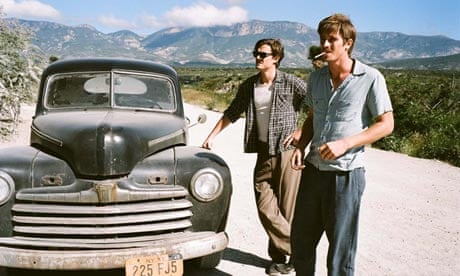
I first met Dean not long after my wife and I split up. I had just
gotten over a serious illness that I won’t bother to talk about, except
that it had something to do with the miserably weary split-up and my
feeling that everything was dead. With the coming of Dean Moriarty began
the part of my life you could call my life on the road. Before that I’d
often dreamed of going West to see the country, always vaguely planning
and never taking off. Dean is the perfect guy for the road because he
actually was born on the road, when his parents were passing through
Salt Lake City in 1926, in a jalopy, on their way to Los Angeles. First
reports of him came to me through Chad King, who’d shown me a few
letters from him written in a New Mexico reform school. I was
tremendously interested in the letters because they so naively and
sweetly asked Chad to teach him all about Nietzsche and all the
wonderful intellectual things that Chad knew. At one point Carlo and I
talked about the letters and wondered if we would ever meet the strange
Dean Moriarty. This is all far back, when Dean was not the way he is
today, when he was a young jailkid shrouded in mystery. Then news came
that Dean was out of reform school and was coming to New York for the
first time; also there was talk that he had just married a girl called
Marylou.
One day I was hanging around the campus and Chad and Tim
Gray told me Dean was staying in a cold-water pad in East Harlem, the
Spanish Harlem. Dean had arrived the night before, the first time in New
York, with his beautiful little sharp chick Marylou; they got off the
Greyhound bus at 50th Street and cut around the corner looking for a
place to eat and went right in Hector’s, and since then Hector’s
cafeteria has always been a big symbol of New York for Dean. They spent
money on beautiful big glazed cakes and creampuffs.
All this time
Dean was telling Marylou things like this: “Now, darling, here we are in
New York and although I haven’t quite told you everything that I was
thinking about when we crossed Missouri and especially at the point when
we passed the Boon ville reformatory which reminded me of my jail
problem, it is absolutely necessary now to postpone all those leftover
things concerning our personal lovethings and at once begin thinking of
specific worklife plans . . .” and so on in the way that he had in those
early days.
I went to the cold-water flat with the boys, and Dean
came to the door in his shorts. Marylou was jumping off the couch; Dean
had dispatched the occupant of the apartment to the kitchen, probably to
make coffee, while he proceeded with his love-problems, for to him sex
was the one and only holy and important thing in life, although he had
to sweat and curse to make a living and so on. You saw that in the way
he stood bobbing his head, always looking down, nodding, like a young
boxer to instructions, to make you think he was listening to every word,
throwing in a thousand “Yeses” and “That’s rights.” My first impression
of Dean was of a young Gene Autry—trim, thin-hipped, blue-eyed, with a
real Oklahoma accent—a sideburned hero of the snowy West. In fact he’d
just been working on a ranch, Ed Wall’s in Colorado, before marrying
Marylou and coming East. Marylou was a pretty blonde with immense
ringlets of hair like a sea of golden tresses; she sat there on the edge
of the couch with her hands hanging in her lap and her smoky blue
country eyes fixed in a wide stare because she was in an evil gray New
York pad that she’d heard about back West, and waiting like a longbodied
emaciated Modigliani surrealist woman in a serious room. But, outside
of being a sweet little girl, she was awfully dumb and capable of doing
horrible things. That night we all drank beer and pulled wrists and
talked till dawn, and in the morning, while we sat around dumbly smoking
butts from ashtrays in the gray light of a gloomy day, Dean got up
nervously, paced around, thinking, and decided the thing to do was to
have Marylou make breakfast and sweep the floor. “In other words we’ve
got to get on the ball, darling, what I’m saying, otherwise it’ll be
fluctuating and lack of true knowledge or crystallization of our plans.”
Then I went away.
During the following week he confided in Chad King
that he absolutely had to learn how to write from him; Chad said I was a
writer and he should come to me for advice. Meanwhile Dean had gotten a
job in a parking lot, had a fight with Marylou in their Hoboken
apartment—God knows why they went there—and she was so mad and so down
deep vindictive that she reported to the police some false trumped-up
hysterical crazy charge, and Dean had to lam from Hoboken. So he had no
place to live. He came right out to Paterson, New Jersey, where I was
living with my aunt, and one night while I was studying there was a
knock on the door, and there was Dean, bowing, shuffling obsequiously in
the dark of the hall, and saying, “Hel-lo, you remember me—Dean
Moriarty? I’ve come to ask you to show me how to write.”
“And where’s
Marylou?” I asked, and Dean said she’d apparently whored a few dollars
together and gone back to Denver—“the whore!” So we went out to have a
few beers because we couldn’t talk like we wanted to talk in front of my
aunt, who sat in the living room reading her paper. She took one look
at Dean and decided that he was a madman.
In the bar I told Dean,
“Hell, man, I know very well you didn’t come to me only to want to
become a writer, and after all what do I really know about it except
you’ve got to stick to it with the energy of a benny addict.” And he
said, “Yes, of course, I know exactly what you mean and in fact all
those problems have occurred to me, but the thing that I want is the
realization of those factors that should one depend on Schopenhauer’s
dichotomy for any inwardly realized . . .” and so on in that way, things
I understood not a bit and he himself didn’t. In those days he really
didn’t know what he was talking about; that is to say, he was a young
jailkid all hung-up on the wonderful possibilities of becoming a real
intellectual, and he liked to talk in the tone and using the words, but
in a jumbled way, that he had heard from “real intellectuals” —although,
mind you, he wasn’t so naive as that in all other things, and it took,
him just a few months with Carlo Marx to become completely in there with
all the terms and jargon. Nonetheless we understood each other on other
levels of madness, and I agreed that he could stay at my house till he
found a job and furthermore we agreed to go out West sometime. That was
the winter of 1947.
One night when Dean ate supper at my house—he
already had, the parking-lot job in New York—he leaned over my shoulder
as I typed rapidly away and said, “Come on man, those girls won’t wait,
make it fast.”
I said, “Hold on just a minute, I’ll be right with you
soon as I finish this chapter,” and it was one of the best chapters in
the book. Then I dressed and off we flew to New York to meet some girls.
As we rode in the bus in the weird phosphorescent void of the Lincoln
Tunnel we leaned on each other with fingers waving and yelled and talked
excitedly, and I was beginning to get the bug like Dean. He was simply a
youth tremendously excited with life, and though he was a con-man, he
was only conning because he wanted so much to live and to get involved
with people who would otherwise pay no attention to him. He was conning
me and I knew it (for room and board and “how-to-write,” etc.), and he
knew I knew (this has been the basis of our relationship), but I didn’t
care and we got along fine—no pestering, no catering; we tiptoed around
each other like heartbreaking new friends. I began to learn from him as
much as he probably learned from me. As far as my work was concerned he
said, “Go ahead, everything you do is great.” He watched over my
shoulder as I wrote stories, yelling, “Yes! That’s right! Wow! Man!” and
“Phew!” and wiped his face with his handkerchief. “Man, wow, there’s so
many things to do, so many things to write! How to even begin to get it
all down and without modified restraints and all hung-up on like
literary inhibitions and grammatical fears . . .”
“That’s right, man,
now you’re talking.” And a kind of holy lightning I saw flashing from
his excitement and his visions, which he described so torrentially that
people in buses looked around to see the “overexcited nut.” In the West
he’d spent a third of his time in the poolhall, a third in jail, and a
third in the public library. They’d seen him rushing eagerly down the
winter streets, bareheaded, carrying books to the poolhall, or climbing
trees to get into the attics of buddies where he spent days reading or
hiding from the law.
We went to New York—I forget what the situation
was, two colored girls—there were no girls there; they were supposed to
meet him in a diner and didn’t show up. We went to his parking lot where
he had a few things to do—change his clothes in the shack in back and
spruce up a bit in front of a cracked mirror and so on, and then we took
off. And that was the night Dean met Carlo Marx. A tremendous thing
happened when Dean met Carlo Marx. Two keen minds that they are, they
took to each other at the drop of a hat. Two piercing eyes glanced into
two piercing eyes—the holy con-man with the shining mind, and the
sorrowful poetic con-man with the dark mind that is Carlo Marx. From
that moment on I saw very little of Dean, and I was a little sorry too.
Their energies met head-on, I was a lout compared, I couldn’t keep up
with them. The whole mad swirl of everything that was to come began
then; it would mix up all my friends and all I had left of my family in a
big dust cloud over the American Night. Carlo told him of Old Bull Lee,
Elmer Hassel, Jane: Lee in Texas growing weed, Hassel on Riker’s
Island, Jane wandering on Times Square in a benzedrine hallucination,
with her baby girl in her arms and ending up in Bellevue. And Dean told
Carlo of unknown people in the West like Tommy Snark, the clubfooted
poolhall rotation shark and cardplayer and queer saint. He told him of
Roy Johnson, Big Ed Dunkel, his boyhood buddies, his street buddies, his
innumerable girls and sex-parties and pornographic pictures, his
heroes, heroines, adventures. They rushed down the street together,
digging everything in the early way they had, which later became so much
sadder and perceptive and blank. But then they danced down the streets
like dingledodies, and I shambled after as I’ve been doing all my life
after people who interest me, because the only people for me are the mad
ones, the ones who are mad to live, mad to talk, mad to be saved,
desirous of everything at the same time, the ones who never yawn or say a
commonplace thing, but burn, burn, burn like fabulous yellow roman
candles exploding like spiders across the stars and in the middle you
see the blue centerlight pop and everybody goes “Awww!” What did they
call such young people in Goethe’s Germany? Wanting dearly to learn how
to write like Carlo, the first thing you know, Dean was attacking him
with a great amorous soul such as only a con-man can have. “Now, Carlo,
let me speak—here’s what I’m saying . . .”. I didn’t see them for about
two weeks, during which time they cemented their relationship to
fiendish allday-allnight talk proportions.
Then came spring, the
great time of traveling, and everybody in the scattered gang was getting
ready to take one trip or another. I was busily at work on my novel and
when I came to the halfway mark, after a trip down South with my aunt
to visit my brother Rocco, I got ready to travel West for the very first
time.
Dean had already left. Carlo and I saw him off at the 34th
Street Greyhound station. Upstairs they had a place where you could make
pictures for a quarter. Carlo took off his glasses and looked sinister.
Dean made a profile shot and looked coyly around. I took a straight
picture that made me look like a thirty-year-old Italian who’d kill
anybody who said anything against his mother. This picture Carlo and
Dean neatly cut down the middle with a razor and saved a half each in
their wallets. Dean was wearing a real Western business suit for his big
trip back to Denver; he’d finished his first fling in New York. I say
fling, but he only worked like a dog in parking lots. The most fantastic
parking-lot attendant in the world, he can back a car forty miles an
hour into a tight squeeze and stop at the wall, jump out, race among
fenders, leap into another car, circle it fifty miles an hour in a
narrow space, back swiftly into tight spot, hump, snap the car with the
emergency so that you see it bounce as he flies out; then clear to the
ticket shack, sprinting like a track star, hand a ticket, leap into a
newly arrived car before the owner’s half out, leap literally under him
as he steps out, start the car with the door flapping, and roar off to
the next available spot, arc, pop in, brake, out, run; working like that
without pause eight hours a night, evening rush hours and after-theater
rush hours, in greasy wino pants with a frayed fur-lined jacket and
beat shoes that flap. Now he’d bought a new suit to go back in; blue
with pencil stripes, vest and all—eleven dollars on Third Avenue, with a
watch and watch chain, and a portable typewriter with which he was
going to start writing in a Denver rooming house as soon as he got a job
there. We had a farewell meal of franks and beans in a Seventh Avenue
Riker’s, and then Dean got on the bus that said Chicago and roared off
into the night. There went our wrangler. I promised myself to go the
same way when spring really bloomed and opened up the land.
And this was really the way that my whole road experience began, and the things that were to come are too fantastic not to tell.